


The broader idea-economy thesis is about what becomes valuable when AI makes output abundant. This earlier primer looks at the interface shift underneath that thesis: natural language becoming a practical way to move from rough intent to first draft, prototype, and review loop.
AI is shrinking the gap between describing an idea and testing a rough version of it. The limiting factor is shifting from pure implementation capacity toward the quality of the problem, the clarity of the thinking, and the judgment behind what gets built.
The Great Inversion: From Code To Natural Language
For decades, turning ideas into digital reality required crossing a large implementation gap. Visionaries needed technical co-founders, development teams, or years learning to code. The journey from concept to creation was often long, expensive, and full of technical hurdles.
Today, natural language has become a more powerful creative interface. With advances in AI, especially large language models and multimodal systems, more people can describe what they want and get a draft, prototype, design direction, content structure, or code path they can inspect.
This represents a meaningful democratization of creative and technical power. Technical implementation still matters, but more people can now participate earlier in the creation process.
The New Creative Stack
This transformation has created what I call the "new creative stack," where ideas can move through a shorter path to a first version:
- Ideation: Human creativity identifies problems and imagines solutions
- Articulation: Ideas are expressed in natural language, refined through conversation
- Generation: AI translates natural language into functional outputs (code, designs, content)
- Refinement: Humans review, provide feedback, and guide iteration
- Integration: The output integrates into larger systems, products, or workflows
What changes is not that technical complexity disappears. It is that more of the early exploration can happen before a full build commitment. The human work shifts toward clearer intent, better constraints, careful review, and responsible integration.
A founder might describe a customer onboarding workflow in plain language. AI can turn that into a first flow, draft copy, a data-model sketch, or a decision brief. But the valuable step is not the draft itself. It is the review loop: what assumption is being tested, what risk needs a human decision, what requires technical validation, and what should not be built yet.
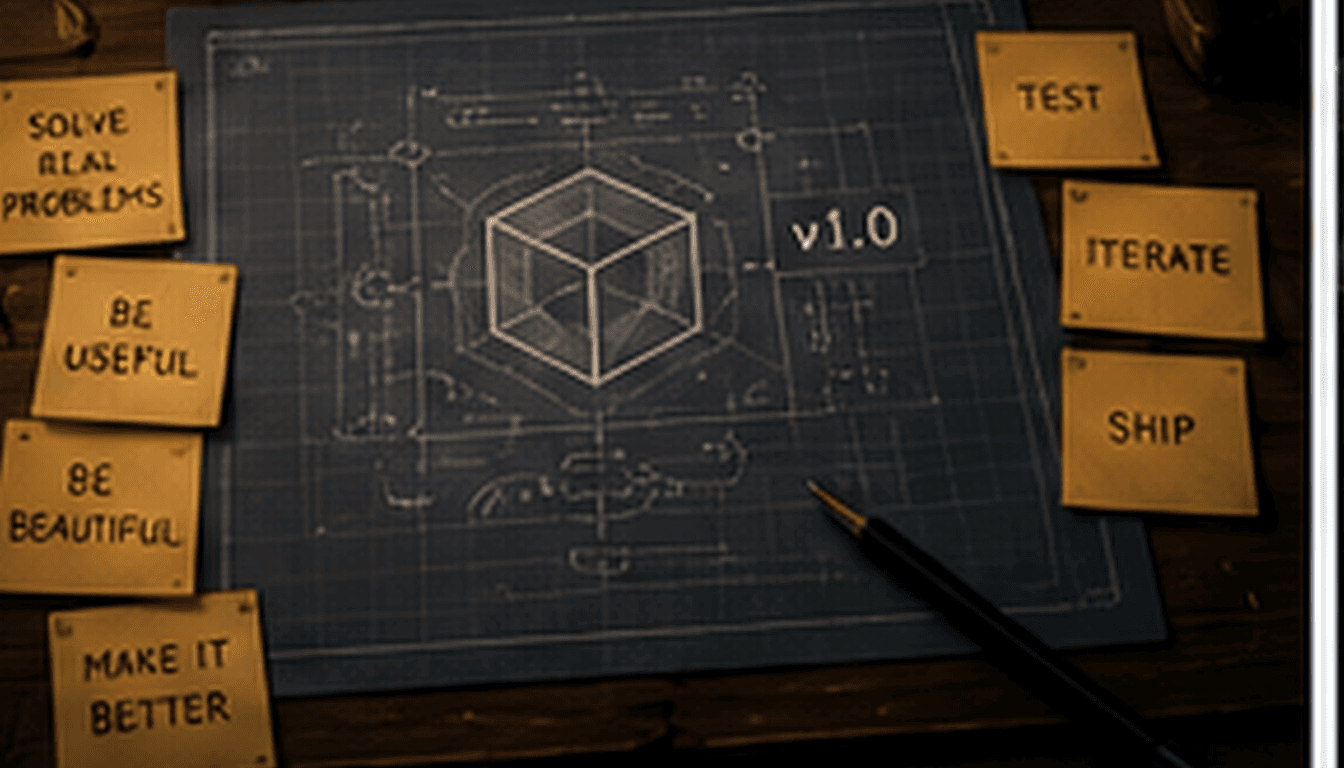
Seeds To First Shoots
Ideas are still seeds, but the first shoots can appear much faster.
- A rough concept can become a prototype.
- A meeting insight can become a decision brief.
- A product direction can become a testable workflow.
This acceleration changes not just the pace of innovation but its nature. When first-version cycles shorten, creators can:
- test more ideas;
- explore directions that previously felt too expensive to try;
- iterate from real feedback instead of only theoretical projections;
- focus resources on finding the right ideas rather than only executing known ones.
The New Essential Skills
As early implementation barriers fall, the critical skills shift. Technical programming knowledge remains valuable, especially for production systems, but it is no longer the only gateway to early creation. The most valuable capabilities increasingly include:
- Conceptual clarity: The ability to formulate clear, coherent ideas
- Mental models: Frameworks for understanding complex systems and problems
- Critical thinking: Evaluating options, outcomes, and implications
- Effective communication: Articulating ideas with precision and nuance
- Strategic vision: Connecting individual solutions to larger purposes
- Adaptability: Quickly incorporating feedback and evolving approaches
These "idea muscles" become the new limiting factors in innovation. The question is no longer "Can we build this?" but "Should we build this?" and "What exactly should we build?"
Beyond Individual Creation: Collaborative Intelligence
While the Idea Economy empowers individual creators, its strongest effects emerge when people and AI work in shared context.
The collaborative version is more interesting: teams moving from messy idea articulation to durable outputs and bounded follow-through without losing shared context.
When teams collaborate in this new pattern:
- Ideas build upon each other more fluidly.
- First versions can emerge alongside ideation.
- Feedback cycles tighten.
- The collective intelligence of the group has more to work with.
Democratization And Access
One important aspect of this shift is its democratizing potential. When natural language becomes a more capable creation interface, early creation is less limited to people with technical training or resources to hire technical teams.
This can open earlier experimentation to:
- entrepreneurs in developing economies;
- experts in non-technical domains;
- people with strong ideas but limited technical backgrounds;
- organizations that previously could not afford extensive development resources.
The barriers now are primarily access to AI tools and the thinking skills to use them effectively, both challenges we must address if this shift is going to benefit more than the people already closest to the tools.
The Challenges Ahead
This transformation brings significant challenges alongside its opportunities:
- Idea quality becomes paramount: When anyone can implement, the differentiator becomes the quality of thinking
- Information overload accelerates: More creation means more to filter and evaluate
- Critical evaluation skills lag: Our ability to produce has outpaced our ability to wisely assess what we're producing
- Access inequities remain: Not everyone has equal access to the tools of the Idea Economy
These challenges require not just technological solutions but cultural and educational evolutions—new ways of teaching thinking skills, evaluating ideas, and ensuring broad access to these powerful capabilities.
Conclusion
We are entering an era where articulation, judgment, and shared context matter more. In this Idea Economy, those who develop sharper thinking strategies and better collaboration patterns will have an advantage.
The question is no longer only what's technically possible, but what we can imagine, express clearly, test responsibly, and carry forward together.
Further reading
- MIT Sloan, How AI is reshaping workflows and redefining jobs
- Anthropic, Building effective agents
- NIST AI Risk Management Framework
- For the fuller 2026 category thesis, read The Idea Economy Is Here.